Summer 1805
Napoleon Bonaparte, the greatest military commander of the age, a general who has swept all opposition before him, stands on the shore of France and gazes wistfully across the mere handful of watery miles known as the English Channel which separate him from England itself. With him are over 300,000 men of the Grande Armèe, one of the most dominating military assemblages of history, waiting only for the opportunity to cross over and march on London, capital city of their archenemy Britain and seat of all opposition to the French Revolution and the glories of France. Napoleon pushes the toe of his boot into the waters of the Channel. If he can only control this narrow sea lane for just a few hours then England will be overcome, its small army pushed aside, London taken and European hegemony will surely be his.
Napoleon knows that the Spanish were in just such a situation in 1588. And he knows that their mighty Armada failed. He does not know that in 135 years the Germans will also be in the same situation - and that in 1940 their Luftwaffe will also fail. But today is 1805 and he is Napoleon Bonaparte. And Napoleon Bonaparte has done his political and military homework.
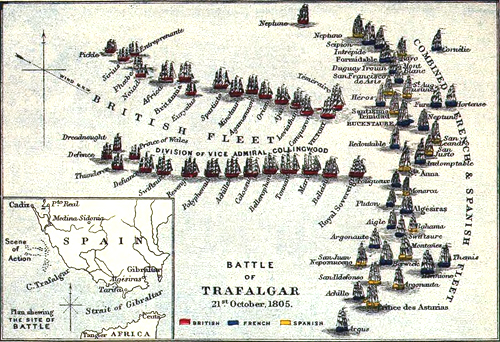
The French fleet has successfully rendezvoused and combined with the fleet of his ally Spain. Together these two allies form a powerful seafaring ensemble which outnumbers the British navy in number of ships, size of ships, size of crews and number of cannon. Towering in the midst of the flotilla is a gargantuan Spanish ship mounting nearly 140 guns, the most powerful naval weapon afloat. If French Admiral Villeneuve can either slip past the British fleet to the Channel or make use of his mighty flotilla combining the power of two nations to defeat the British ... then England will be at Napoleon's mercy.
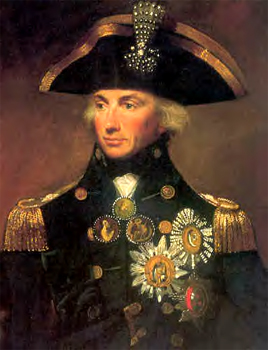
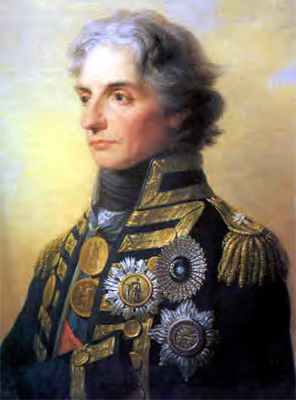
But the English are a seafaring people. And while France may have the greatest military commander of the age, England possesses the greatest seafaring genius, Admiral Lord Horatio Nelson. Nelson is a determined and innovative commander with impressive victories under his belt and the loss of an arm and an eye as marks of his courage, dedication and steadfastness in battle. But he has never faced an opponent this powerful before, or with so much riding on the result of the contest.
Villeneuve gains an initial advantage as he eludes Nelson with a feint toward the Caribbean and its valuable sugar producing colonies. But Nelson recovers and catches up with the Franco-Spanish fleet off the west coast of Spain near a place called Cape Trafalgar. There, the three most powerful navies on earth face each other in a two against one showdown. The stage is set for one of the epic naval battles of history, one which will determine the future of England, Europe and the World.
October 21st, 1805
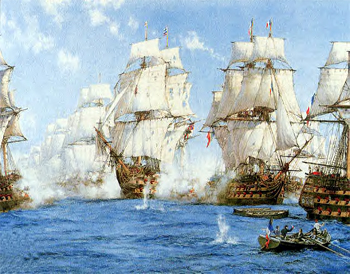
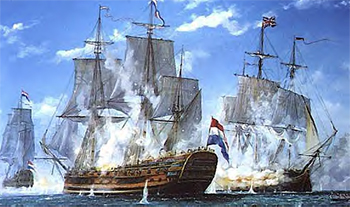
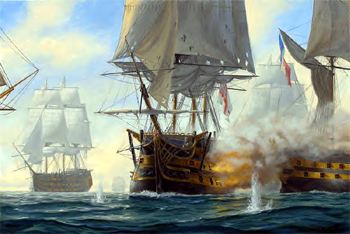
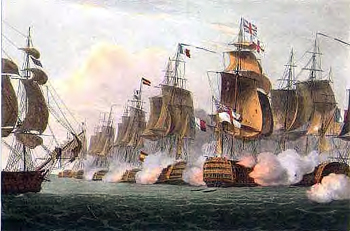
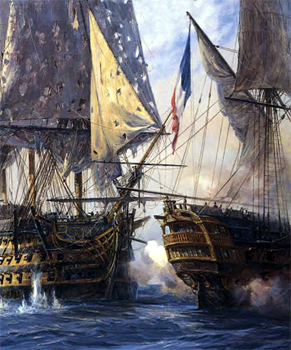
From his flagship HMS Victory, Nelson makes his famous signal to the fleet urging that "England expects that every man will do his duty!" and seizing the initiative with a bold and unorthodox advance, allows the French and Spanish to strike the first blow in exchange for maneuvering to hit the enemy fleet at the places of his choosing. Surviving the initial enemy broadsides, the English ships are soon among the ships of France and Spain, fighting at close quarters where the superior discipline of the British crews can shine. The melee is vicious and confused. Order largely dissolves in the chaos but it is clear that the higher rate of British fire and willingness of British captains to grapple, board and fight it out with pistol and cutlass are taking a toll on their enemies. Even more worrisome to Villeneuve is that due to where Nelson has engaged him, a part of the French fleet has wind and distance against it and will not be able to bring its weight to bear anytime soon. Though some of Villeneuve's crews fight bravely, others seem half-hearted and French and Spanish ships begin to surrender. Many English ships are dismasted and some no more than floating hulks but not a one has struck its colors. Audacity, courage and perseverance are clearly winning the day.
At the height of the battle Nelson himself goes down, pierced by a musket ball fired by a Tyrolean sharpshooter from the rigging of a French ship. Within hours Lord Admiral Horatio Nelson will have died and one of the greatest naval commanders of the ages will pass into history. But the day is his. The combined navies of France and Spain have been defeated. The threat against England is no more.
In France Napoleon sulks but soon seeks glory against his opponents on the European continent. In England there is tremendous rejoicing over the nation's greatest deliverance since 1588 but also sorrow at the loss of so brilliant and dedicated a leader.
The seapower of France and Spain has been broken. They will never again threaten England with invasion. Nelson has done his duty.
Lord Scott ©2005
We Make History
Proudly Presents
Lord Nelson's
Victory Ball
October 15th, 2005